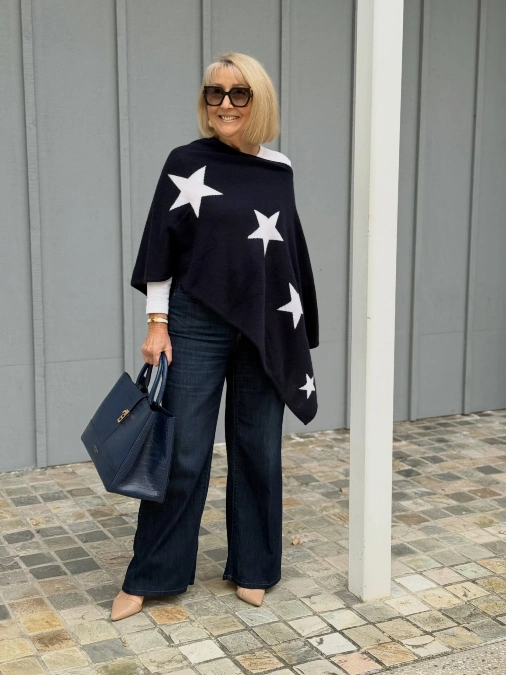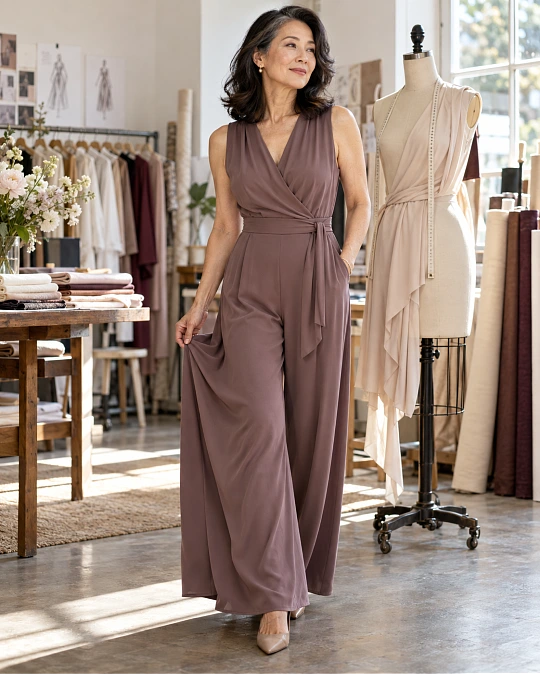
How to Wear a Jumpsuit Over 50 So It Fits and Flatters Perfectly
A jumpsuit can be one of the easiest one-piece outfits to wear, but getting the fit right makes all the difference. When the torso is too short, the waist sits in the wrong place, or the fabric has too little movement, even an attractive jumpsuit can feel uncomfortable.
For women over 50, the best jumpsuit is not necessarily the smallest size or the trendiest cut. It is the one that works with your proportions, gives you enough room to move, and creates a clean line without feeling restrictive.
Small details such as torso length, waistband placement, fabric weight, hem length, shoes, and outer layers can completely change how the finished outfit looks.
Key Takeaways
- Check torso length before focusing on the size printed on the label.
- Choose a waist placement that feels comfortable and visually balanced.
- Look for fabrics that skim the body instead of clinging or standing stiffly away from it.
- Match the leg shape and hem length with your shoes.
- Use cropped jackets, blazers, and open layers to preserve the jumpsuit’s shape.
The Right Torso Length Matters More Than the Size on the Label

Image Credit: Sagely Chic
When trying on a jumpsuit, start by checking the torso rather than immediately looking at the waist or leg width. The distance between your shoulders and crotch needs to be long enough for the garment to sit naturally on your body.
A torso that is too short can cause several problems at once. The neckline may move upward, the waist can sit higher than intended, and the fabric may pull uncomfortably when you sit or bend.
Extra torso length can create the opposite effect. Excess material may gather around the waist or crotch, making the garment appear loose in areas where you wanted a cleaner shape.
Do more than stand still in front of the fitting-room mirror. Sit down, lift your arms, bend slightly, and take a few steps. Those movements reveal fit problems that may not be obvious while standing.
| Fit Area | What to Check | Why It Matters |
|---|---|---|
| Shoulders | Seams should sit close to your natural shoulder line | Helps the upper body look balanced |
| Bust | Fabric should lie smoothly without pulling | Keeps the neckline and waist in place |
| Torso | Enough room to sit, bend, and move | Prevents pulling through the middle and crotch |
| Waist | Seam or belt should sit comfortably | Creates shape without digging into the body |
| Seat and hips | Fabric should skim rather than stretch tightly | Allows the trouser section to fall smoothly |
Fit note: A hem that needs shortening or a waist that needs minor adjustment can often be altered. A torso that is fundamentally too short is much harder to fix.
Let the Waist Sit Where Your Body Wants It to Sit

Image Credit: Sagely Chic
A jumpsuit does not have to cinch at the narrowest point of your waist to look polished. The most flattering position is often the one that feels comfortable and creates a natural visual balance.
A slightly higher waist can make the legs appear longer, especially when paired with straight or wide trousers. However, if the waistband sits immediately below the bust, the silhouette can become more empire-like than intended.
A lower waist can work particularly well with relaxed utility styles. What matters is that the placement looks intentional and does not appear as though the garment has slipped out of position.
If your jumpsuit has a fabric tie, avoid pulling it so tightly that it creates bunching. A relaxed knot can provide enough definition while allowing the fabric to fall naturally.
You can also switch a very thin self-tie for a medium-width belt when the garment has suitable belt loops. A simple leather belt can add structure without making the outfit complicated.
Choose Fabric That Skims Instead of Fighting the Body
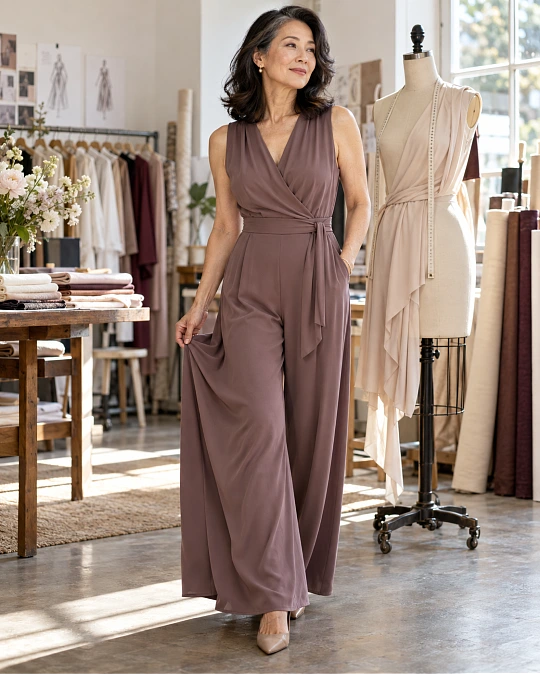
Image Credit: Sagely Chic
Fabric can determine whether a jumpsuit feels comfortable and polished or restrictive and unforgiving. The right cut can still look wrong if the material does not move well with your body.
Very lightweight jersey may feel soft, but it can cling to areas you would rather keep visually smooth. Extremely stiff fabric can have the opposite problem, creating unnecessary volume instead of following the body’s natural movement.
Look for materials with enough weight to drape cleanly while still offering movement. Crepe, soft twill, fluid woven fabrics, substantial jersey, lightweight denim, and Tencel-style materials can all be useful depending on the style and occasion.
The fabric should follow the overall shape of the jumpsuit without outlining every layer underneath it. That balance gives the outfit structure while keeping it comfortable.
A little stretch can make a big difference
A modest amount of stretch can be especially helpful in a tailored jumpsuit. It allows easier movement when sitting, driving, walking, and reaching.
Too much stretch can create another issue, particularly after several hours of wear. Knees and the seat may lose their shape, so a fabric with a combination of structure and flexibility is often more practical.
Use the Neckline and Leg Shape to Balance the Whole Jumpsuit
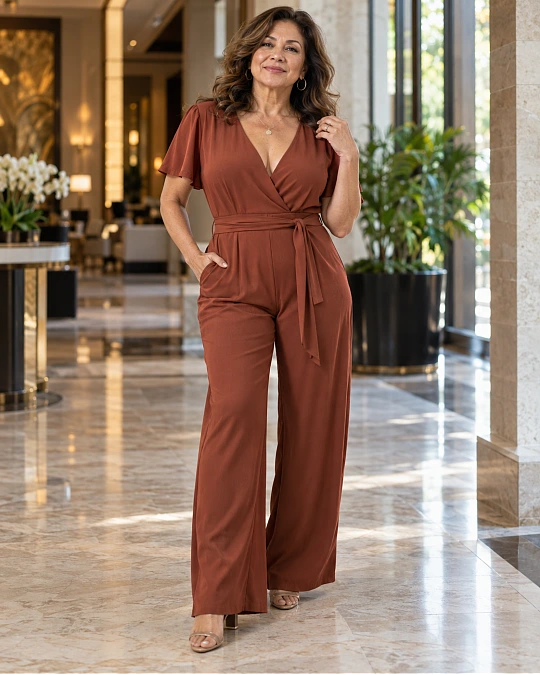
Image Credit: Sagely Chic
Because a jumpsuit creates one continuous outfit from top to bottom, the neckline and trouser shape have a major effect on the overall proportion.
If the legs are very wide and fluid, a simpler neckline can keep the outfit looking balanced. V-necks, open collars, wrap-style fronts, and clean scoop necklines can create visual space around the upper body.
Straight-leg jumpsuits are particularly versatile for everyday wardrobes. They give you definition without creating an extremely fitted silhouette.
Wide-leg jumpsuits can look elegant when the fabric has good movement and the waist has some definition. Pay close attention to the hem, because too much fabric collecting around the shoes can make the whole outfit appear heavier.
Tapered jumpsuits can be excellent for casual outfits as long as the leg narrows gradually instead of becoming tight around the calves.
Try this: Instead of inspecting the jumpsuit only from close range, step several feet away from a full-length mirror. The extra distance makes it easier to judge the balance between your shoulders, waist, and legs.
Make the Shoes Work With the Hem, Not Against It
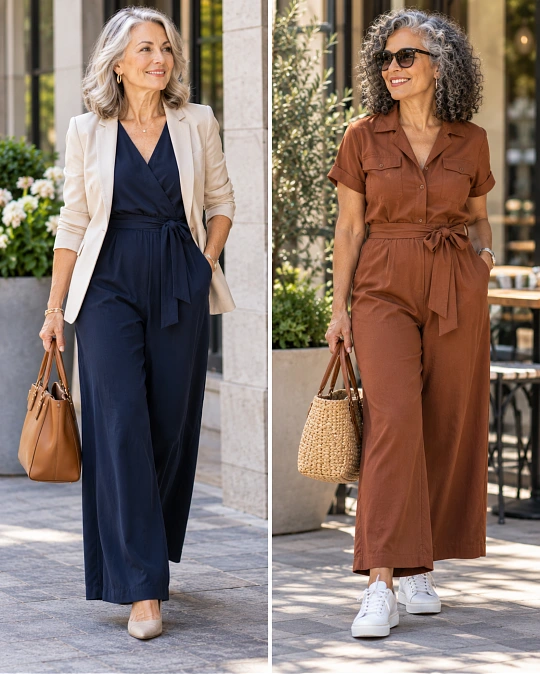
Image Credit: Sagely Chic
The shoes do not need to be attention-grabbing, but they should work with the jumpsuit’s length and leg shape.
Wide-leg jumpsuits generally look cleaner when the hem falls close to the shoe instead of ending at an awkward point. Depending on the occasion, a block heel, wedge, pointed flat, or sleek loafer can work well.
Cropped and ankle-length jumpsuits offer more flexibility. Sneakers, ballet flats, loafers, sandals, and low heels can all work when the exposed ankle looks intentional.
The important thing is the relationship between the hem and shoe. A deliberate ankle gap can look crisp and modern, while a trouser that is simply too short can make the outfit appear unfinished.
| Occasion | Shoes | Layer or Accessory |
|---|---|---|
| Everyday errands | Clean sneakers or flat loafers | Crossbody bag and lightweight cardigan |
| Lunch with friends | Ballet flats or low block heels | Simple earrings and structured handbag |
| Work or smart casual | Loafers, slingbacks, or low pumps | Blazer or refined knit jacket |
| Dinner | Heeled sandals or pointed flats | Clutch and more noticeable jewelry |
| Travel | Supportive sneakers | Soft jacket and roomy tote |
This versatility is one of the biggest advantages of a good jumpsuit. Changing your shoes and accessories can shift the outfit from casual to polished without requiring a completely different base.
Add Layers Without Hiding the Shape

Image Credit: Sagely Chic
Since a jumpsuit already covers most of the body, adding a bulky outer layer can sometimes make the entire outfit look like one large block.
Cropped jackets, short cardigans, waist-length denim jackets, and shorter blazers are useful because they preserve some of the jumpsuit’s shape and keep the leg line visible.
Longer layers can also work when they are worn open. A straight cardigan, lightweight trench, or longline blazer can create two vertical lines around the jumpsuit instead of completely hiding it.
Consider the volume of the base garment when choosing the outer layer. A wide jumpsuit often benefits from a slightly more structured jacket, while a tailored jumpsuit can be softened with a relaxed cardigan or fluid coat.
Color note: A layer in a similar color family can make the outfit feel longer and more streamlined. A contrasting layer creates more separation and can make the jumpsuit look less formal.
Small Fit Problems Can Make a Good Jumpsuit Look Wrong
Sometimes the jumpsuit itself is not the problem. One small fit detail may simply be disrupting the proportions.
Before abandoning a style completely, identify exactly where the issue occurs. A different torso length, hem adjustment, belt, or leg shape may solve the problem without requiring an entirely different outfit.
- If the waist tie creates bunching: loosen it slightly or replace it with a cleaner belt.
- If the crotch pulls when you sit: look for more torso length instead of automatically sizing up.
- If wide legs feel overwhelming: try a straighter cut or a version with slightly less volume.
- If the neckline feels too open: add a lightweight camisole or choose a similar neckline with more coverage.
The most useful approach is to solve the specific problem rather than assuming jumpsuits in general do not work for you.
| Fit Problem | Possible Solution |
|---|---|
| Too much bunching at the waist | Relax the tie or try a more structured belt |
| Torso pulls when moving | Look for a longer rise or torso length |
| Hem gathers around shoes | Have the length adjusted for your regular footwear |
| Thin fabric clings | Choose a fabric with more weight and drape |
| Long jacket hides the jumpsuit | Try a shorter layer or wear a long layer open |
Professional alterations can also make a meaningful difference. Adjusting a hem or refining a waist can sometimes transform a jumpsuit that was almost right into one that feels much more natural.
A Jumpsuit Formula You Can Repeat Without Overthinking It
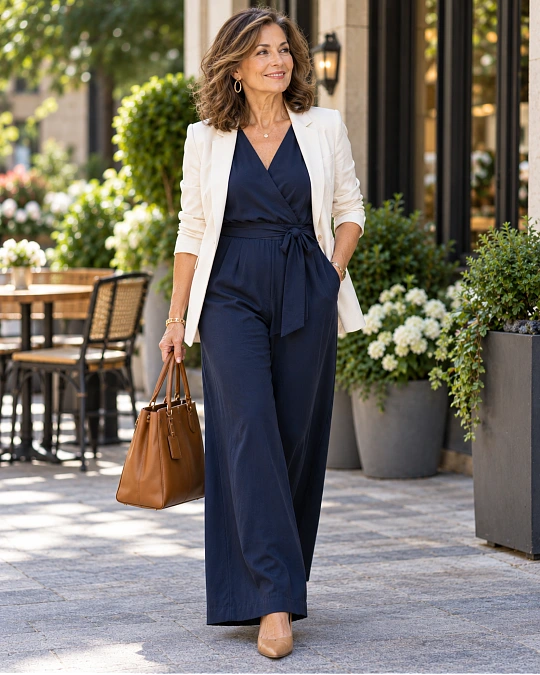
Image Credit: Sagely Chic
Once you find a jumpsuit with the right torso, waist, fabric, and leg shape, styling it can be remarkably simple. The one-piece silhouette already does most of the work.
Formula: fluid straight-leg jumpsuit + comfortable waist definition + simple shoes + one structured finishing piece.
For daytime, the finishing piece could be a cropped jacket, leather tote, or polished loafer. For an evening look, switch to simple jewelry and a low heel.
This approach works particularly well for travel and busy mornings because you are not coordinating multiple separates.
| Mood | Jumpsuit | Finishing Pieces | Overall Effect |
|---|---|---|---|
| Relaxed | Soft utility jumpsuit | Sneakers + crossbody bag | Comfortable with some structure |
| Polished | Straight-leg belted jumpsuit | Loafers + structured tote | Clean and smart |
| Elegant | Fluid wide-leg jumpsuit | Low heels + simple jewelry | Long, graceful silhouette |
| Weekend | Cropped jumpsuit | Flats + denim jacket | Relaxed and easy |
Once you understand which proportions suit you, a jumpsuit can become one of the easiest pieces in your wardrobe. The right one gives you a complete base, leaving only shoes, accessories, and an optional layer to decide.
Frequently Asked Questions
What style of jumpsuit is most flattering for women over 50?
There is no single jumpsuit shape that works for every woman. Straight-leg and softly wide-leg styles are useful places to begin because they create a clean line without requiring an extremely fitted silhouette.
Pay particular attention to torso length, waist placement, fabric, and leg shape. Those details have a much bigger effect on the finished fit than the number on the size label.
Should a jumpsuit be loose or fitted?
A comfortable amount of ease is usually more useful than either an extremely tight or completely oversized fit. You should be able to sit, walk, bend, and raise your arms without the fabric pulling.
If both the upper and lower sections are very loose, some gentle waist definition can help the outfit maintain a clear shape.
Can you wear a jumpsuit if you have a tummy?
Yes. Look for fabrics that skim rather than cling and check where the waist seam, belt, pockets, and other details fall across the middle.
A straight or softly wide leg can also create balance. The goal is not to hide your body but to find a garment that hangs naturally without pulling in uncomfortable places.
What jacket looks best over a jumpsuit?
Cropped jackets and shorter blazers often work well because they preserve the long leg line. Longer cardigans, trenches, and open-front blazers can also look polished when they create a clean vertical frame.
The best option depends on the volume and structure of the jumpsuit. A very wide jumpsuit may benefit from more structure on top, while a tailored style can work with something softer.
Can a jumpsuit be part of everyday outfits for women over 50?
Definitely. A comfortable utility jumpsuit or straight-leg style can be just as practical for everyday wear as jeans and a top.
Choose a fabric that allows comfortable movement and pair it with shoes that suit your routine. Sneakers, loafers, flats, and low heels can all change the mood without requiring a completely different outfit.