Shopping for clothes can become frustrating when something looks perfect in the store but feels completely wrong once you get home. Maybe the waistband feels uncomfortable, the fabric clings, or the new jacket does not work with anything already hanging in your closet.
Learning how to shop for clothes over 50 is less about following strict fashion rules and more about becoming intentional about fit, fabric, comfort, and everyday usefulness.
Your wardrobe does not need to be bigger. It needs pieces that suit the life you actually live and that you will genuinely want to wear.
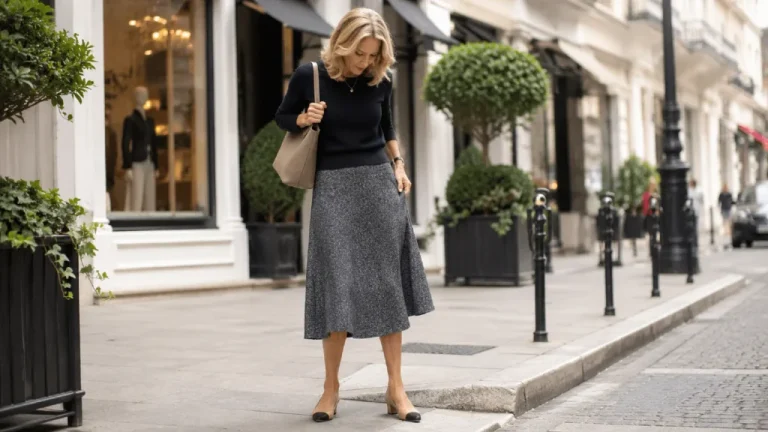
Stop Shopping for an Imaginary Version of Your Life
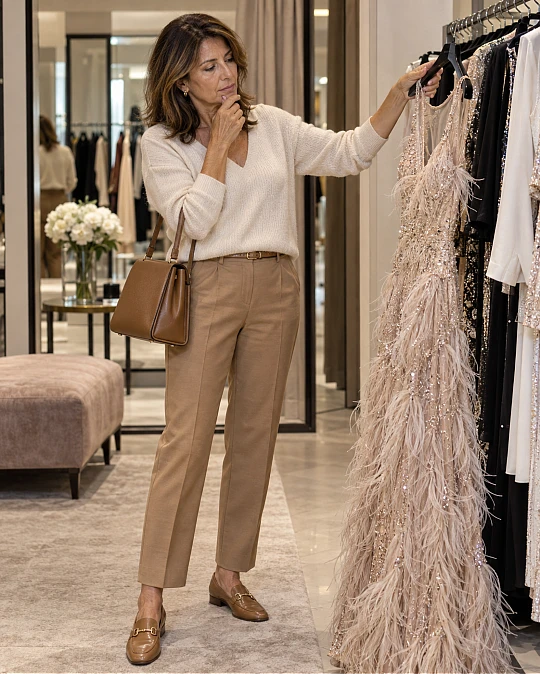
Image credit: Sagely Chic.
One of the easiest ways to waste money on clothing is to buy for a lifestyle you rarely experience.
A glamorous blouse may look wonderful on the rack, but if most of your week consists of errands, casual lunches, appointments, travel, family time, or working from home, another easy-to-wear top may give you far more value.
Before shopping, decide what job the new item needs to perform.
Instead of thinking, “I need some new clothes,” try something more specific: “I need a comfortable top that works with my dark jeans and trousers for lunches and everyday outings.”
That simple change can prevent impulse purchases because you are looking for a solution instead of simply reacting to whatever catches your attention.
Think about the situations that actually fill your calendar. Your wardrobe might need clothing for:
- Casual daytime activities
- Work, volunteering, or appointments
- Lunches, dinners, and social plans
- Travel days
- Walking and everyday errands
- Occasions that require a slightly more polished outfit
These categories do not need to be equal.
If most of your days are casual, it makes sense for the majority of your wardrobe to support casual dressing. That makes everyday outfits for women over 50 easier to create without constantly searching for something new.
Try this: Before shopping, complete this sentence: “I need something that…” If you cannot clearly explain what you need, wait before buying.
Fit the Woman You Are Dressing Today, Not the Size on the Tag
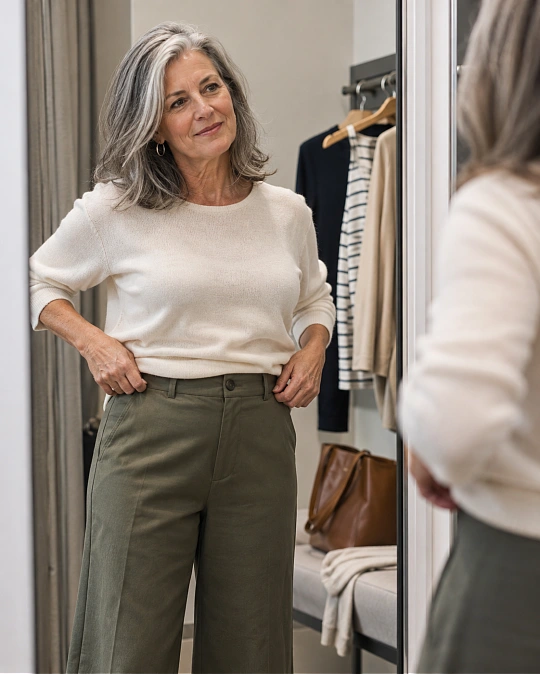
Image credit: Sagely Chic.
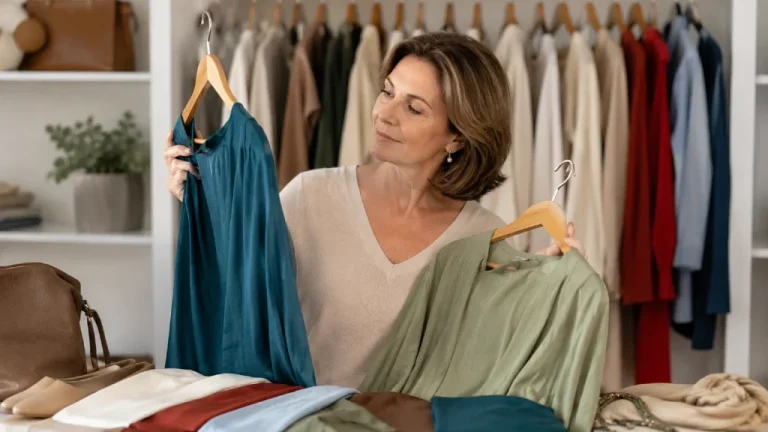
The number printed on a clothing label should never be treated as the final judge of fit.
Garments with the same size can look completely different because designers use different cuts, fabrics, proportions, rises, sleeve shapes, and amounts of stretch.
When possible, take two nearby sizes into the fitting room. Concentrate on how each garment looks and feels rather than trying to make yourself fit a particular number.
Some areas deserve extra attention because they are harder to alter later. Check the shoulders of jackets, the rise of trousers, the armholes of tops, and the position of a dress waist.
A useful garment should let you move without constantly pulling, tugging, covering, or readjusting it.
Use this quick fitting-room checklist:
| Area to Check | What You Want to See | Warning Sign |
|---|---|---|
| Shoulders | Seams sitting naturally on your shoulders | Pulling across the back or fabric collapsing |
| Bust | Smooth fabric without strain | Buttons pulling or excess fabric sticking out |
| Waist | Comfortable shape without pressure | Band digging in, rolling, or slipping |
| Hips | Fabric falling smoothly while standing and sitting | Horizontal lines or obvious pulling |
| Sleeves | Enough room for natural movement | Restricted armholes or twisting sleeves |
Do not judge an outfit while standing completely still in front of the mirror.
Sit down. Walk around. Reach forward. Raise your arms. Cross them. Bend slightly.
Clothing has to work when you are living your life, not just when you are posing in a fitting room.
Fabric Can Make a Good Cut Look Expensive or Completely Wrong
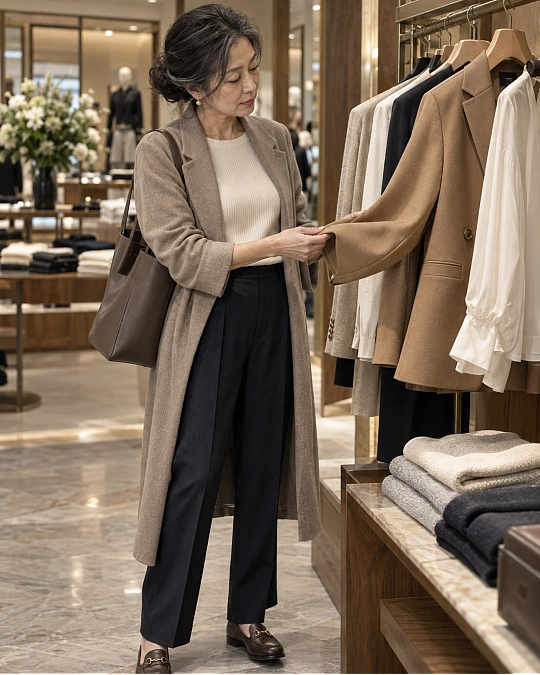
Image credit: Sagely Chic.
Even a flattering silhouette can disappoint when the fabric behaves badly.
Fabric affects how a garment hangs, whether it keeps its shape, how easily it wrinkles, and how comfortable it feels after several hours of wear.
For trousers, look for enough weight to create a smooth line without making the garment feel stiff or heavy.
With tops and dresses, notice how the material falls across your body. A fabric with gentle movement can create a softer appearance than one that is extremely thin or tightly clinging.
Knits also deserve a closer look.
Very thin knits can reveal every layer underneath, while very chunky knits may create more bulk than you intended. Medium-weight knits can often offer a useful balance between comfort, structure, and layering.
Stretch should also serve a purpose. A little stretch can make clothing easier to move in, but excessive stretch can sometimes make a garment lose its shape quickly.
Fabric test: Gently squeeze a section of the fabric in your hand. If it becomes badly wrinkled immediately, consider whether you really want a garment that may need frequent ironing or steaming.
| Fabric or Construction | What to Look For | Why It Can Work Well |
|---|---|---|
| Midweight knit | Soft drape with reliable recovery | Comfortable without looking overly thin |
| Structured cotton | Enough body to maintain its shape | Useful for polished shirts and lightweight jackets |
| Fluid viscose blends | Movement without excessive sheerness | Works well for relaxed tops and dresses |
| Stretch woven fabric | Moderate stretch with structure | Provides comfort while maintaining a clean shape |
| Linen blends | Linen combined with another fiber | Offers a relaxed appearance with potentially easier care |
There is no universal fabric that every woman over 50 needs to buy.
The better question is whether the material performs well for your comfort, climate, lifestyle, and preferred level of clothing care.
Check the Proportions Before You Blame Your Body
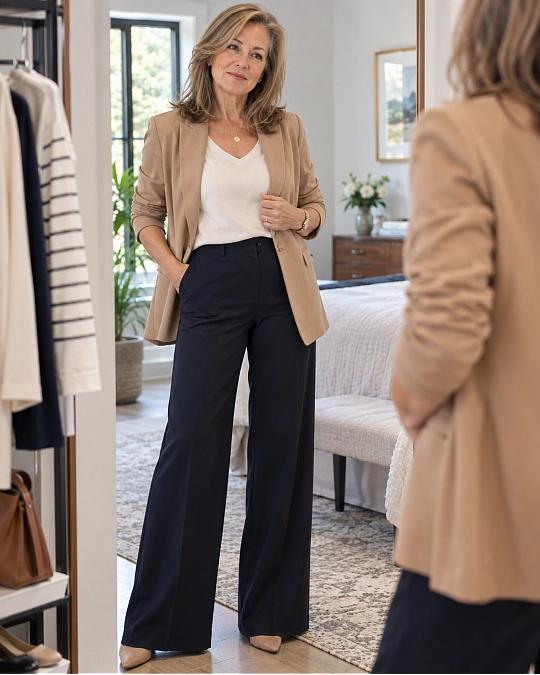
Image credit: Sagely Chic.
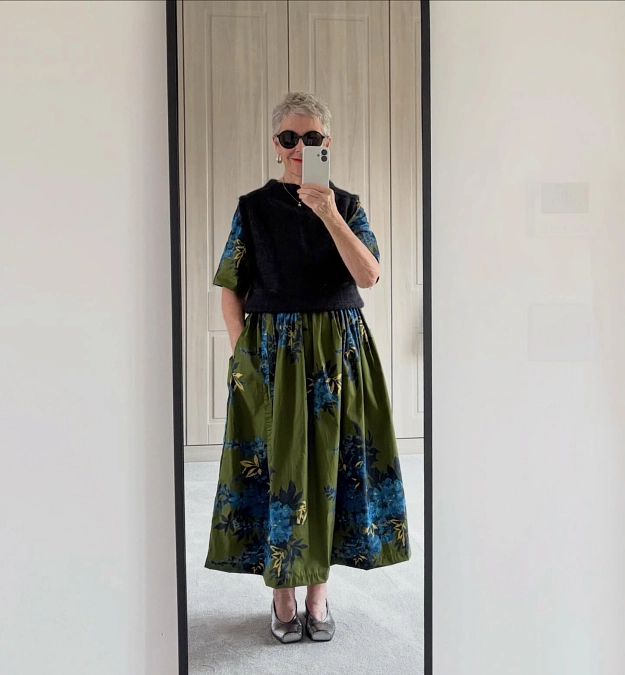
Sometimes a garment is not the problem at all. The issue may be how the pieces are working together.
For example, a loose long blouse paired with very wide trousers can create a large uninterrupted shape. That does not automatically mean you need to eliminate either piece.
Try changing the proportions instead.
A half-tuck, a shorter top, an open neckline, a structured jacket, or a straighter trouser can completely change the appearance of the same outfit.
The same principle is useful while shopping. A sweater may seem unflattering with the leggings you happen to be wearing, even though it could look much better with the straight-leg jeans you wear regularly.
When possible, bring or wear something similar to the pieces you plan to pair with your new purchase.
Do not forget about shoes.
Wide-leg trousers can look very different with bare feet compared with loafers, sleek trainers, ankle boots, or a low block heel.
A midi skirt can also change visually depending on where the shoe stops and how much of the leg remains visible.
This is where style confidence over 50 can become much easier. Instead of asking whether you are “allowed” to wear something, look at how the complete outfit is balanced.
You are not trying to follow every fashion rule.
You are figuring out what the individual piece needs around it to work for you.
Watch for the Shopping Habits That Create Closet Regret
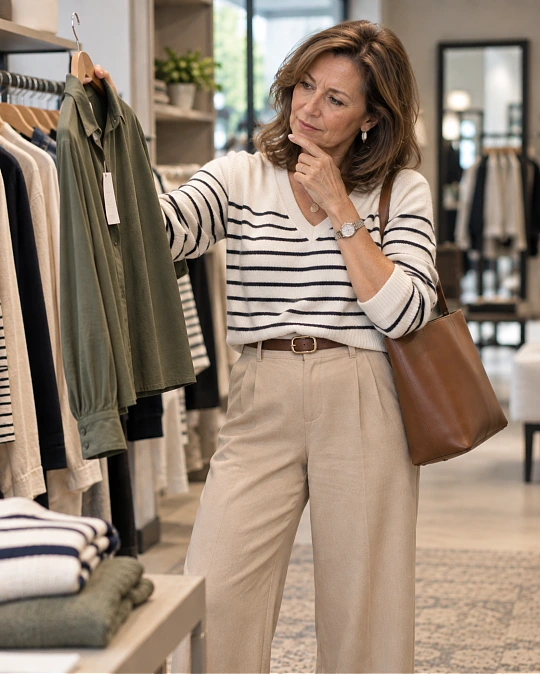
Image credit: Sagely Chic.
Most wardrobe mistakes are not dramatic fashion failures.
They are ordinary purchases that seemed reasonable at the time.
Maybe the blouse was almost right. Maybe the shoes looked beautiful but became uncomfortable after ten minutes. Maybe the trousers only worked with one specific top and one particular pair of shoes.
Those “almost” purchases can slowly fill a closet with clothing that rarely gets worn.
| Instead of This | Try This |
|---|---|
| Buying simply because something is heavily discounted | Ask whether you would still want it without the sale price |
| Keeping a piece that needs constant adjustment | Look for a cut that feels natural once you put it on |
| Buying for a possible future body change | Choose clothing for the body you are dressing today |
| Choosing a trend that requires several new purchases | Find a version that works with your existing wardrobe |
| Assuming uncomfortable shoes will become comfortable | Walk, sit, and move before making the purchase |
| Buying without considering footwear | Identify at least one pair of shoes you already own that works with it |
Another common issue is buying several versions of something you already own without adding anything useful.
There is nothing wrong with owning multiple black trousers or white shirts if those are pieces you wear frequently. The important question is whether each version serves a different purpose.
One white shirt might be crisp enough for tailored outfits. Another could be softer for weekends. A third might work beautifully as an open layer over a tank top.
That is useful repetition.
Several nearly identical pieces that all lose to the same favorite item are more likely to create clutter than convenience.
Budget-friendly rule: If you already own something similar, the new piece should improve at least one important area such as fit, comfort, fabric, versatility, or condition.
Use the Three-Outfit Test Before You Buy Anything
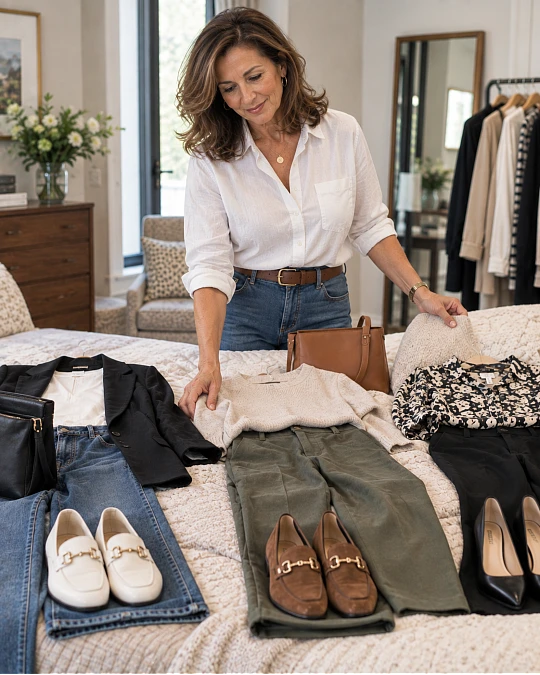
Image credit: Sagely Chic.
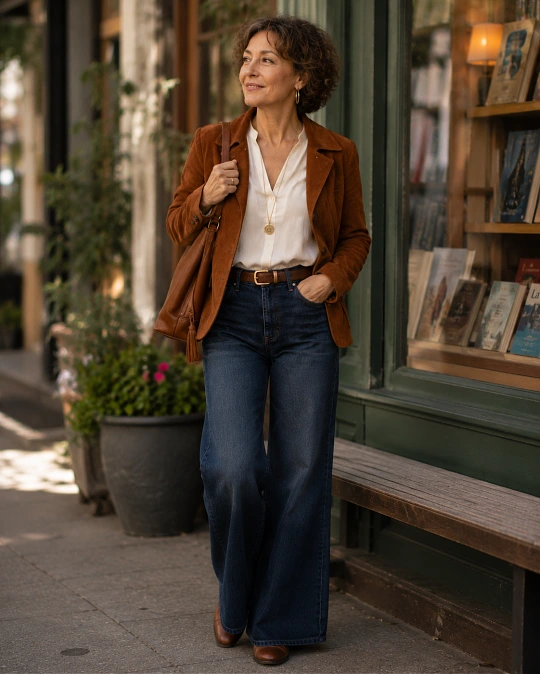
A practical way to avoid unnecessary purchases is to stop judging new clothing by itself.
Before buying something, create three different outfits using pieces and shoes you already own.
Do not count outfits that depend on something you plan to buy later.
For example, a camel cardigan might work with dark jeans and loafers, black trousers and flats, and a printed midi skirt with boots.
That gives you several realistic reasons to wear it.
Now compare that with a jacket that needs new trousers, new shoes, a special top, and a different bag. The real cost of that jacket is much greater than the price shown on its tag.
This test can be especially useful when building a capsule wardrobe over 50, because each new purchase should ideally connect with several outfits you already wear.
| Occasion | Simple Formula | Why It Works |
|---|---|---|
| Everyday errands | Straight-leg jeans + knit top + lightweight jacket | Comfortable basics with enough structure for a polished look |
| Lunch with friends | Relaxed trousers + fluid blouse + loafers | Soft fabrics balanced with a neat finishing piece |
| Smart casual event | Midi dress + cropped jacket + low heel | Simple proportions without complicated layering |
| Travel day | Pull-on trousers + fine knit + long cardigan + trainers | Easy movement with flexible layers |
A simple buying formula to remember is:
Fits now + works with three existing pieces + suits your real life.
When a garment meets all three conditions, it has a much stronger chance of becoming a regular part of your wardrobe.
If it only passes the “this looks beautiful” test, give yourself a little more time before purchasing.
Build a Shopping List From the Outfits That Keep Failing
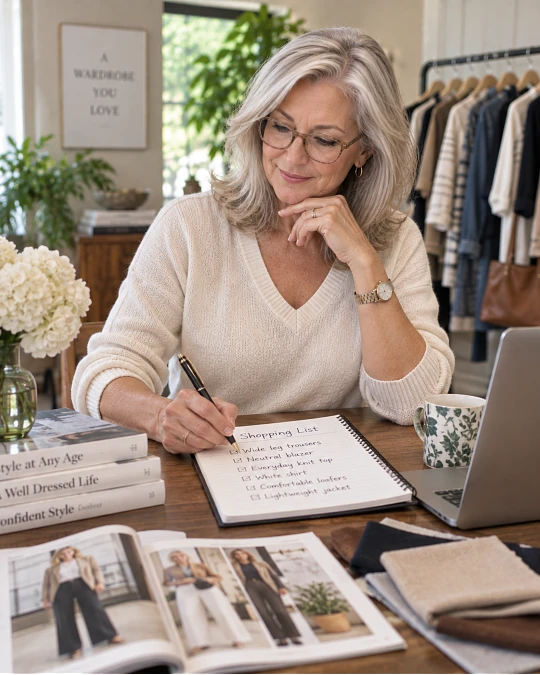
Image credit: Sagely Chic.
You do not have to replace your entire wardrobe to make dressing over 50 simpler.
Instead, pay attention to the outfits that repeatedly cause problems.
Perhaps your wardrobe needs a comfortable pair of dark trousers. Maybe you have plenty of tops but not enough lightweight layers. Or perhaps your dresses are fine but your current shoes no longer work comfortably with them.
Those recurring problems are telling you what to shop for next.
Keep your list specific enough that you can recognize the right item when you see it.
“Black trousers” is vague.
“Black straight-leg trousers with a comfortable mid-rise, clean front, and enough structure for dinners and appointments” is much more useful.
The same idea applies to color.
If your wardrobe already includes navy, cream, denim, camel, and burgundy, an unusual bright color can be fun, but consider how many existing pieces it can connect with before buying it.
You do not have to avoid experimentation.
The goal is simply to make sure new colors, prints, and silhouettes have a realistic place in your wardrobe.
Color note: Hold a new color next to two or three pieces you wear frequently. This can quickly show whether the new shade will create several outfits or remain an isolated purchase.
Intentional shopping may feel slower in the beginning.
But once you know exactly what your wardrobe needs, shopping often becomes faster because you can ignore many items that were never right for you.
Frequently Asked Questions
How do I stop buying clothes I never wear?
Give every purchase a clear purpose before you buy it. Try to identify at least three pieces you already own that can work with it and one real situation where you would wear it.
If you cannot answer either question, pause before purchasing. Something can be attractive without being practical for your wardrobe.
Should women over 50 follow fashion trends?
You can enjoy fashion trends without changing your entire wardrobe every season.
Choose individual trends that fit your personal style and comfort. A new shoe shape, color, jacket style, or trouser silhouette can refresh familiar outfits without making you feel like you are wearing someone else’s style.
How can I tell if clothes fit properly in the fitting room?
Test the garment while moving instead of judging it only while standing in front of the mirror.
Sit down, walk, raise your arms, turn sideways, and reach forward. Watch for pulling, twisting, gaping, sliding waistbands, restricted movement, or anything that makes you want to keep adjusting the garment.
Is it better to buy fewer expensive clothes after 50?
Price by itself does not determine whether a garment is a smart purchase.
A reasonably priced jacket that you wear several times a week may provide more value than an expensive dress that leaves the closet after one occasion.
Consider fit, fabric, comfort, care requirements, versatility, and realistic frequency of wear before focusing on the price tag.
How do I know what clothes to get rid of before shopping?
Begin with pieces you repeatedly avoid because the fit, fabric, color, comfort, or overall feel no longer works for you.
You do not need to empty your entire closet in one afternoon. Removing a few consistently unsuccessful pieces can make your genuine wardrobe gaps much easier to identify.
Final thought: Learning how to shop for clothes over 50 does not require following complicated fashion rules. Start with your real lifestyle, check the fit while moving, pay attention to fabric, consider the complete outfit, and only bring home pieces that have a clear place in your wardrobe.